The female gaze is not a pink outfit, and it is not just a romance movie. The theory is not a genre, nor is it a movement against men. The female gaze is much more than that.
Where It All Started: The Male Gaze
Before we came to terms with the idea that media can and should be made for the female gaze as well, we were introduced to the male gaze. Laura Mulvey, filmmaker and film critic, introduced the male gaze in her essay ‘Visual Pleasure and Narrative Cinema’ in 1975. Her idea was that everything around us, including film, was created for men’s eyes, especially the depiction of women. Mulvey went deeper into explaining how visual artists objectified women, reducing them to objects existing solely for men's pleasure. Cait Caffrey, editor and writer, has said, “Rooted in psychoanalytic theory, the male gaze reflects broader societal dynamics where women are often seen as objects rather than subjects.”
In plain words, until the last decade, women were seen as something to look at, and not somebody who could be a main character with a deeper story and feelings.
So What Is the Female Gaze?
The female gaze is not the opposite of the male gaze but rather an extension of who women are beyond their looks. It is a shift in whose interiority we center. The female lens is about whose desires, fears, ambitions, and contradictions drive the story. It is how women are seen through the eye of another woman, with good, bad, and ugly truth behind it.
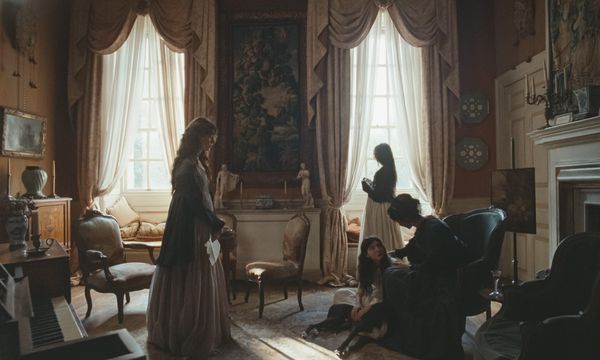
Films seen through the female gaze matter for women and men equally — to understand, and to feel. The best example of that is ‘Little Women’ (2019), the story of a girl whose aspirations are bigger than those that society tries to put her in; she wants to be a writer, not a mother or a wife. ‘Portrait of a Lady on Fire’, ‘Promising Young Woman’, and ‘Mad Max Fury Road’ are all films where the camera notices different things beyond what women look like. In Portrait of a Lady on Fire, the camera lingers on a woman's hands at work. In a male gaze film, it would linger on her face for his reaction. That difference — small, specific, everything — is what we mean.
Why It Matters More Than Ever in 2026
In the 2026 landscape, this conversation is becoming louder and more prominent. The effect of a Barbie movie, revival of classic romcoms, and various BookTok adaptations are all proof that the female audience is finally being taken seriously as a commercial force as well. This is not a niche conversation. Female directors like Greta Gerwig, Kathryn Bigelow, Chloe Zhao, Ava DuVernay, and many others are getting recognition on a big stage. Female actresses, like Emma Stone, Florence Pugh, Saoirse Ronan, and Tilda Swinton, are not afraid to show emotion and the complex side of women’s existence.
What This Means for Filmoiselle
Filmoiselle covers everything — hot news, casting announcements, trailers, fan theories, and the drama that keeps the industry moving. But we also go deeper. We ask the questions a male-dominated publication might not think to ask. We profile the female producer behind the blockbuster, break down why a film resonates differently through a woman's eyes, and notice what the camera is doing when nobody else is paying attention. You can come for a quick read and leave with something to think about. We mix business and pleasure over here — and we would not have it any other way.
You don’t have to be a woman to enjoy Filmoiselle; there is something here for everybody, whether you come for the news or you come to learn and think.
Welcome to Filmoiselle
What does Filmoiselle mean? It is an intersection of film and mademoiselle — the French word for a young woman who answers to nobody. We cover everything the industry produces — the news, the casting announcements, the trailers, the box office, the drama. Not every story we tell has a female angle, and it doesn't need to. But when we go deeper, when we write about a director's filmography or break down why a film resonates, that is where our lens becomes visible. The female gaze is not our gimmick. It is our default setting — not a filter over everything, but a perspective that shapes what we notice, what we ask, and what we think is worth saying.
Welcome to Filmoiselle.