The Filmoiselle Interview: Emily Isaacs and the Art That Comes from the Heart
Award-winning writer and filmmaker Emily Isaacs on her first vertical micro-drama The Diamond Thief, the women whose stories go unheard, and why the best way to be understood is to tell a story.
The award-winning writer and filmmaker on her first vertical micro-drama, the women whose stories go unheard, and why the best way to be understood is to tell a story
There is a line Emily Isaacs returns to, almost as a creed, about an hour into our conversation. "In order for art to be art, it has to come from the heart," she tells us, and then, because she is a writer and cannot leave an idea half-made, she keeps going. "The underlying story has to have some sort of reasoning or purpose or fire behind it." It is the sort of thing that could sound like a slogan coming from anyone else. From Isaacs, who has built an entire creative life out of necessity, conviction, and sheer refusal to be told what she cannot do, it sounds like a description of the only way she knows how to work.
Her path to filmmaking did not run in a straight line, and when we ask whether it felt like one creative journey or a series of separate chapters, she laughs at the question of hindsight. "When you're in it, you don't have any kind of idea of what is ahead," she says. "It's only when you look back that you realise quite how far you've come, and how the different areas of your life shape who you become." She wanted to be a writer as a child, was drawn to drama from the age of six or seven, and then met the same wall so many creative women describe to us: the teacher, the gatekeeper, the voice from above deciding she was the wrong shape or the wrong kind of pretty for the thing she loved. She invokes Kate Winslet, who was famously told she was too fat to act and went on anyway. "Sometimes I was a bit like that," Isaacs admits. "But at other times it really does affect you, and you just think, maybe I should listen to them."
She listened, for a while. Told there was no money in writing and no job in acting, she was steered toward the cello, which she was good at, and she turned it into twenty years as a professional cellist. It is a vocation she describes with real clarity about its cost. "Physically, it's like being an athlete," she says, "and it's also a very lonely life. It's like writing." The loneliness is a thread she pulls on more than once, and it is also, we come to understand, the reason filmmaking eventually saved her, because filmmaking is the one art form she practises that insists on other people. "What makes that bearable is when you bring the filmmaking side into it, because that has to be collaborative. You have to have other people around you to make it work."
The return to writing came through the hardest door. In 2009, a relapse of Sjögren's, an autoimmune condition she likens to MS or lupus, left her mostly bed-bound for around five years. Teaching the cello, even from home, became impossible, and it was her husband Gino, "always my biggest supporter," who pointed her back toward the page. He suggested she study at the University, because that was something she could do from bed. She earned her degree that way, from a bed she could not leave, and when she started to recover she went on to an MA in Cultural and Creative Industries. "If it weren't for him," she says simply, "I wouldn't have done my degree."
What happened next has the quality of a story she might write herself. One of her cello students brought his father to a lesson, the two got chatting, and the father turned out to be a film director about to make an indie horror. Isaacs signed on, at first, only as crowdfunding manager, thinking it would dovetail neatly with her MA. She ended up production-managing the entire thing, the horror feature 13 Graves, from start to finish. "A real trial by fire," she says, "two years of learning all about how films are made. And that was it. I got the bug." Out the other side, she and Gino set up their production company, Scriptworks, and she began to write in earnest.
The accolades came quickly, and they have not stopped. She reached the finals of the BAFTA Rocliffe New Writing competition in 2021, was selected for BFI Doc Labs in 2022, joined the Jed Mercurio writing scheme in 2023, and completed the Women in Film and Television Screenwriting Lab in 2024. In 2025, she won Creative Queens, and this year she attended the Edinburgh TV Festival as a Bursary Delegate. When we put the full list to her, she deflects with characteristic modesty. "You just do your best, don't you?"
"She's worked magic with it"
The reason we are talking now is The Diamond Thief, Isaacs's first vertical micro-drama, which was still in production as we spoke, being filmed in pieces around the cast's availability. The project grew out of that Creative Queens win, and it is impossible to tell its story without telling the story of the woman who made it happen: Jane Sanger, who ran the competition and championed Isaacs's work from the start.
Creative Queens, Isaacs explains, is a competition for women over forty, and winning it sent her to a writers' retreat in a castle in the Spanish countryside, the Rocaberti Writers Retreat. For a woman who had spent years largely at home, simply getting there was its own quest. "I was like, my god, I've won this amazing competition, now I actually have to get to the middle of nowhere in Spain." A powered wheelchair and a great deal of planning got her through the airports and up the castle stairs. The prize's second act took her to the Birmingham Film and TV Market to pitch, where she brought The Diamond Thief, adapted on everyone's advice from a pilot into a feature. BBC Film and Film4 loved it but had no capacity. And then Sanger wrote to her.
"She said, look, I really want to get this made somehow, some way. Can we make it as a micro-drama?" Isaacs recalls. She licensed Sanger the rights to adapt it, kept the pilot and feature back "just in case, because you never know," and watched Sanger do what she had promised. The admiration in Isaacs's voice is total. "She's worked magic with it. She's sourced the most amazing locations, we've got some brilliant cast in there, and the crew has just been phenomenal." She is quick to push back on the horror stories that haunt indie production, the exhausting hours and the people falling asleep at the wheel. "Somehow Jane always manages to make it work so that it's not too much. Everyone's just amazing." Sanger, she tells us, has far bigger plans, more micro-dramas, a platform of her own. "She's got all these amazing ideas. She's a phenomenal lady, actually, really switched on."
What Sanger and Isaacs have built together is, by design, the opposite of the thing currently flooding everyone's feeds. The micro-drama runs on real locations, real actors, a real script and a proper story, and Isaacs draws the contrast sharply. "I can't think of anything more different from an AI-created plotline," she says. "Quite often they don't make sense, there's no depth behind them, there's no relationships there." Her actors, by contrast, keep coming to her hungry for more. "They're always asking me, tell me more about this character, what's their history, was this a real person?" That last question matters, because mining real history for stories is exactly what both women love to do.
Isaacs is refreshingly honest about the format itself, and she does not pretend the vertical micro-drama has it all figured out. "I think micro-drama is a very complex issue at the moment," she says. "It's very exciting, but there's also a lot of problems being thrown up in the industry. It's a real Wild West out there." At the Edinburgh TV Festival, she says, it was all anyone could talk about. "You've made a vertical micro-drama, how was that? And I'm like, yeah, it's great. But there are some things that need working out, because it's a little bit rocky still." That candour sits comfortably alongside her gratitude, and she is careful to hold both at once. She is, she tells us, genuinely thankful for the chance to have made something on the platform, and sees it as very exciting new territory, the kind of frontier a writer is lucky to get to explore while the rules are still being written.
Would she do it again? "I'll never say never," she says, before offering the single most Emily Isaacs answer of our hour together. "It's like when you go into a bakery. I can't choose. I can't just have one cake. I want to try different ones."
Isaacs is no reflexive technophobe, and her thinking on artificial intelligence is more generous and more precise than most of the takes currently filling the discourse. "I'm not completely anti-AI, don't get me wrong," she says. "I think it's a great productivity tool. It has a certain value in speeding up processes and allowing creatives to get to certain points faster." Her reservation is not about the existence of the tool but about who is holding it, and she reaches for an analogy that lands cleanly. "It's a bit like a calculator. A mathematician is going to get a very different use and result out of a calculator than somebody who's doing grade-six maths. If a professionally trained painter uses a paintbrush, they're going to get a very different result from me, because I can't paint for toffee." The tool, in other words, is only ever as good as the skill and intent behind it. "It all comes down to who's using it and the skill they have to use it. That makes a world of difference."
Where she draws a harder line is on the replacement of human performance, and here she is unequivocal. She brings up Tilly Norwood, the AI "actress" being paraded around the industry, who turned up on Sky News not long before we spoke. "It's just wrong, it just feels wrong," Isaacs says. "She's not that good. She doesn't respond completely as a human would." The uncanny-valley discomfort, for her, is not a glitch to be ironed out but a signal of something fundamental. What makes us human, she insists, is precisely the thing the technology cannot fake. "It's our flaws."
"Although women seem to go on about it a lot, we still don't seem to be being heard. And sometimes it seems like the louder we shout, the more deaf the ears become."
Scriptworks is, by Isaacs's own description, a socially conscious and female-focused company, and when we ask why she built it on those two commitments rather than simply doing what everyone else does, her answer opens out into the heart of why she writes at all. Every story, she believes, whatever its genre, needs a fire underneath it. She points to one of her own horror scripts, a silly, tongue-in-cheek comedy about a band of misfits trying to stop demons from infiltrating a town, and then shows us the engine humming beneath the ridiculousness. "Underneath it is a comment about generational divides and bigotry, and how that leads to conflict." For Isaacs, almost every division we are living through traces back to the same root. "At the heart of it all is hate. It's all about them and us, that otherness. That's what we need to get past."
And then there is the thread that runs through everything she makes. "From a feminist perspective, a lot of my stories are all about how women historically have just been subjugated," she says. "Although women seem to go on about it a lot, we still don't seem to be being heard. And sometimes it seems like the louder we shout, the more deaf the ears become." It is the line of the conversation, and it contains her entire philosophy of storytelling in a single breath, because her response to not being heard is not to shout louder. It is to tell a story. "Part of my reasoning is that sometimes messages are better absorbed through stories."
That instinct, to dig through history, surface a real woman the record has overlooked, and fictionalise her into the present, drives most of what Isaacs has in development. There are more projects than she can count, she says, including one she is keeping close to her chest for now, a project she cannot yet talk about, which is exactly the kind of thing that tells you a filmmaker is in a good season. "You can chip away at it for years and years and have relatively little happen," she says of this strange, patient craft, "and then all of a sudden it just explodes."
We could not let Isaacs go without asking about accessibility, an area where film and television remain, by most measures, well behind. She is measured and fair about it, generous to the people and institutions getting it right while refusing to pretend the work is done. Things are improving, she says. She sees far more discussion of access coordinators brought in from pre-production, and every scheme she enters now asks, as a matter of course, whether she will need any access considerations. She singles out the WFTV Screenwriting Lab and the Edinburgh TV Festival, where an access and inclusion officer met her personally, gave her a tour, and showed her the quiet space. "Some places have really switched on with it."
The gaps she describes are rarely malice and usually imagination. Her trip to Spain was tricky precisely because the organisers had not encountered the need before, which left the logistics largely on her shoulders, though she is quick to add that they were "very sweet and accommodating" once asked. And she returns, with great patience, to the thing people still struggle to grasp: that disability is not always visible, and not always fixed. Hers, she says, changes from hour to hour. Her favourite rebuttal is one we suspect she has deployed many times. "People say, well, why do you use a wheelchair if you can walk? And I'm like, well, why do you use a car? You can't physically walk to the supermarket, can you? It's the same for me; my distance is just much shorter." Her hope is plain and hard-won. "The more we talk about it, the better, because then people will understand more."
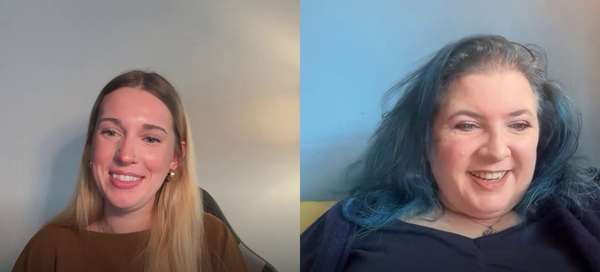
Watch the full conversation
Our full interview with Emily Isaacs is available to watch below, including her thoughts on the collapsing divide between television and platforms like YouTube, the Edinburgh lecture, and why she hopes we never reduce every story down to something that only works on a phone.
Emily Isaacs is a writer, filmmaker, and founder of Scriptworks. Her first vertical micro-drama, The Diamond Thief*, adapted from her BAFTA Rocliffe–finalist pilot and directed and produced by Jane Sanger, is currently in production.*
Daria Ershova is the Founder and Editor-in-Chief of Filmoiselle. She's an entertainment and culture journalist whose film writing appears at Pop Tales and whose commentary has been quoted in Newsweek, Fortune, and British Vogue.