Every election season, the same demand resurfaces. Keep politics out of movies. Let film be an escape. Let a story just be a story. This week, with a vote behind us and half the conversations in the country still circling what it means, that demand is louder than usual. It has always been impossible to meet.
A film cannot be apolitical, because storytelling is not a neutral act. Every story makes choices about who holds power and who does not, whose life is worth following, whose suffering counts and whose is only scenery. Those choices are the raw material of politics. A film does not need to mention an election to take a position on how the world should work. It takes one the moment it shows a world at all.
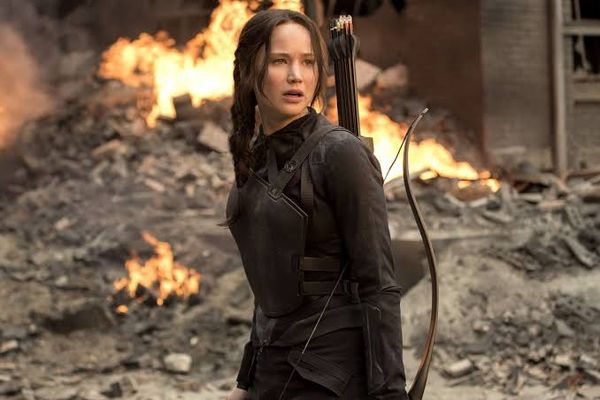
The clearest proof sits inside the genre audiences love most. Dystopia. The Hunger Games is a story about a brutal government that keeps its districts starving and turns their children's deaths into live entertainment. Suzanne Collins has said the idea arrived while she was flipping between reality television and footage of a real war, until the two began to blur. That argument about spectacle and violence is the foundation the whole franchise is built on. The same holds for The Handmaid's Tale, for 1984, for Children of Men, for Snowpiercer and Parasite and their worlds sorted ruthlessly by class. We read these stories as warnings precisely because we understand they are about us.
Some of the sharpest political films are the ones about women's lives, even when they get dismissed as something softer. The Handmaid's Tale is a story about who controls a woman's body. Barbie is a story about what the world demands women be. The Hunger Games handed a generation of girls a heroine who refused to perform for the cameras that wanted her obedient. Centering a woman's experience, treating it as the main event rather than the subplot, is itself a political choice in an industry that spent a century treating it as optional.
This was true before cinema even had sound. In 1925, Sergei Eisenstein made Battleship Potemkin as open revolutionary propaganda, and it reshaped how films are edited to this day. A decade before that, The Birth of a Nation spread a monstrous, racist version of American history so persuasively that it was screened inside the White House and helped revive the Ku Klux Klan. Film proved it could move a nation almost as soon as it learned to move at all. The people who built the medium never imagined it was neutral. That fiction came later, mostly from people already comfortable with the politics baked into the frame.
That is the sleight of hand inside the word "apolitical." A film that reassures you the world is fundamentally fine, that the right people are in charge and the existing order deserves to win, reads as apolitical only because its politics already match the ones in the air around you. Comfort is a position too. A story that never protests anything has still taken a side.
None of this means a good film should sound like a campaign speech. The best political films are rarely the loudest ones. They work because they make you feel the stakes of how we live together before you have the words to name them. Art is one of the few places a society argues with itself about power and fear and justice and who gets to be the hero of the story. Asking movies to stay out of politics is asking them to stop being about anything at all. The films worth remembering have never once agreed to that.
Twelve films that never pretended otherwise
Filmoiselle covers film and television through a female lens.