Fjord Won't Hand You a Verdict
At a sold-out Belgrade screening, the whole room laughed in the same place. Cristian Mungiu's Fjord is a film that changes shape depending on who is watching it.

– 5 min read


At a sold-out Belgrade screening, the whole room laughed in the same place. Cristian Mungiu's Fjord is a film that changes shape depending on who is watching it.
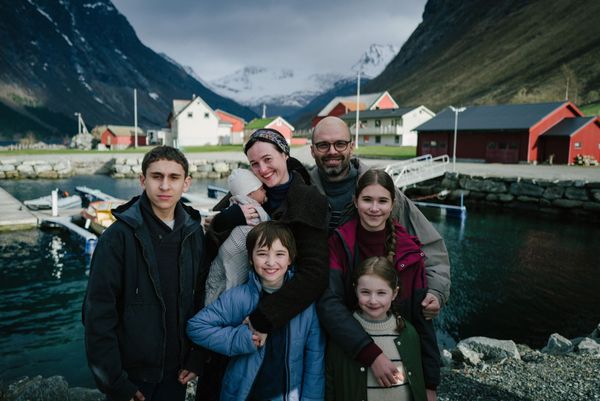
At the Auteur Film Festival in Belgrade, in a theatre of more than a hundred people with every seat taken, a line about hitting children drew a laugh from the entire room. It was the laugh of recognition. The father on screen, played by Sebastian Stan, had said something a great many people in that audience had once heard from their own parents, or said to their own children, and for a moment the film stopped being a story about a family in Norway and became a story about everyone watching it. I have thought about that laugh more than almost anything else in Fjord, because it tells you precisely what the film is after.
Fjord is the latest from Cristian Mungiu, and it unfolds in a remote town in the north of Norway, all cold light and high mountains. A family of immigrants, the mother Norwegian, the father Romanian, their five children speaking Romanian and barely a word of Norwegian, has arrived to begin again. Then the daughter appears at school with bruises, and the machinery of the state begins to turn. The children are taken into care. What follows is the long, procedural unspooling of a child-protection case, the interviews and the hearings and the foster placement and the trial, filmed with the patience of a director who trusts you to sit in the discomfort and reach your own conclusions.
The response has split roughly down the middle. Some have read the film as an attack on Norway and its institutions, a foreign director pointing fingers. That reading feels too easy. Mungiu has never been interested in telling you who is right, and he is not about to start now. He has said the film is meant to begin a conversation rather than close one, and he keeps his word. There is no tidy verdict here, no final scene that reveals what truly happened inside that house, and the film is far stronger for the restraint.
My own sympathies drifted towards the family, though the film never quite lets me rest there. These are people who fled something worse and came looking for safety, strangers in a country whose language they can hardly speak. And yet the case against them keeps dissolving the longer you look at it. In the opening minutes, we watch the children thrown around in a school wrestling class, small bodies hitting the mat hard. Of five siblings, only the daughter carries bruises; the others come home unmarked. The film notices this. The system does not.
Then there is the question of language. The children have been in the country barely a week when they are asked, in a Norwegian they do not yet understand, whether they are being hurt at home. The family's lawyer raises the point the authorities never think to: did anyone ask them in their own tongue, where the distance between a smack and a beating might actually be heard? A child translating their own life under the eyes of strangers makes an unreliable witness, and the film understands this even when the professionals in the room do not.
The contradictions accumulate. The court eventually allows the children home until the criminal trial, and the foster family objects, arguing that moving them again so soon would do them harm. Too much upheaval, too fast. The irony seems to escape everyone, since these same children were taken from their school and their parents without a second thought when the upheaval ran the other way. Religion fares no better. In a country proud of its freedoms, a young child is encouraged to speak openly about their sexuality and discouraged from speaking about their faith. A freedom that applies selectively is a strange sort of freedom, and Mungiu lets the hypocrisy sit on screen without comment.
What comes next deserves a warning, so treat this as the place to stop if you want the film to surprise you.
The family flees. They leave the country altogether, and we never learn what became of them, whether anyone was held to account, whether the parents faced anything at all. We have watched them do everything asked of them, the anger management classes, every box the state demanded they tick, and the reward is a door left open onto nothing. It is devastating, and it is meant to be. Mungiu ends on a question mark because the subject deserves one.
I want to be as fair as the film is, which means admitting the parents are no innocents. They are rigid, devout to the point of control, a household with no phones and little room for a child to simply be a child, where a birthday party becomes a negotiation. Faith is one matter. Sending your children into the world without the tools to live in it is another, and on that count the film spares the family nothing. Fjord holds two uncomfortable truths at once and asks you to carry both out of the cinema.
It is also, plainly, beautiful to look at. Shot in a small Norwegian town, the film makes cold into a visual language: grey skies, blue shadow, snow and mountain, and the far-off threat of an avalanche. The colour does half the emotional work before a word is spoken, settling a darkness over the story that never reaches for cheap suspense. Whoever shot this understood exactly what they were building.
The performances hold all of it together. Sebastian Stan vanishes into the father so completely that you forget to look for the actor, and Renata Reisve matches him as the mother. Better still, the film lets everyone keep their own language. Romanian, Norwegian, a little English, each left intact, nothing smoothed over for the comfort of a subtitle-averse audience. It feels true in a way that films about immigrants, flattened into a single tongue, almost never do.
I was warned the film would be heavy, and in one sense it is, since the sight of children taken from their parents and parents accused of something monstrous is hard to shake. But the film itself is a pleasure, taut and intelligent and oddly generous to everyone inside it. I hope it does what Mungiu intends and starts a real conversation about children who are genuinely in danger and about a system that can mistake difference for proof. I was glad to see a film take child protection seriously. I was just as glad to see it ask whether seriousness, pushed far enough and certain enough of itself, becomes a harm of its own.
Which brings me back to that theatre in Belgrade. A Balkan audience hears a line about a smack differently from an audience in Oslo or New York. Many in that room grew up in a culture that, for a long time, did not call a smack harm. That is not the same as condoning it, and I do not. I only know that the film I watched in Belgrade was not quite the film someone else watched elsewhere, and that may be the truest thing about it. Fjord changes shape depending on who is looking at it. Few films are brave enough to allow that.
Five stars.